
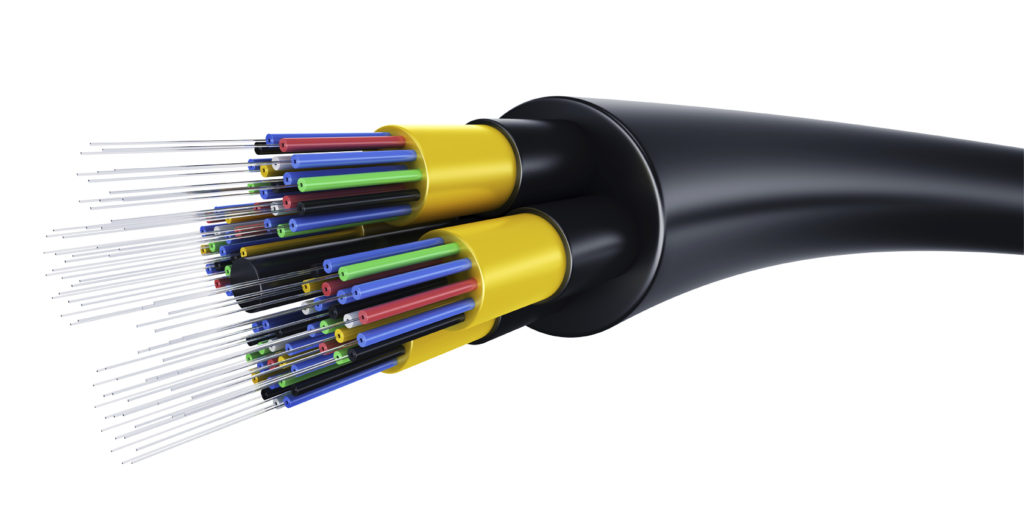
1.GYFTZY non-metallic flame-retardant optical cable
Strictly speaking, the GYFTZY non-metallic flame-retardant optical cable (usually the optical cable The power supply cable (which adopts a layered twisted type) is not a special optical cable for our power supply cable. However, when our power supply optical cable line enters the substation, the substation experiences high current loads and, at the same time, has high requirements for lightning protection and flame retardancy. Therefore, it is necessary to use non-metallic materials and optical cables with good flame retardancy. In the substation section, we generally use GYFTZY non-metallic flame-retardant optical cable. Some people may say, “I think a self-supporting ADSS full dielectric optical cable can be used.” According to the operating conditions of the ADSS full dielectric self-supporting optical cable, it is also suitable for lightning-prone areas and areas with high electrical loads, but compared to the optical cables GYFTZY non-metallic flame retardants, common optical cables, the cost is high and the price/performance ratio is not high.
First, we understand the performance of the optical cable through the letters GYFTZY. GY stands for outdoor optical communication cable; F for non-metallic strength member; T for water-blocking filler; Z for flame retardant; and Y for polyethylene sheath. From the above, we know that its technical characteristics include a flame-resistant sheath, and the loose tube is filled with a special coating to provide key protection to the optical fiber. The full-section water-blocking structure ensures good water and moisture protection. The optical cable is a fully dielectric (non-metallic) structure, lightweight, easy to lay, and has excellent anti-electromagnetic capabilities, making it suitable for power systems and areas prone to lightning storms. The optical cable is typically laid through conduit at the station. The minimum bending radius is 20 times the outer diameter of the optical cable during laying; 10 times the outer diameter of the optical cable when the laying is complete.
2. Self-supporting, fully dielectric ADSS optical cable
He ADSS optical cable It adopts a loose-tube layered braided structure. The 250 μm optical fiber is inserted into a loose tube made of high-modulus material, and the loose tube is filled with a waterproof compound. The loose tubes (and filler strands) are braided around a non-metallic (FRP) core to form a compact cable core, and the spaces in the core are filled with water-blocking grease. The inner polyethylene (PE) jacket is extruded from the cable core, then the aramid fiber is braided in for reinforcement, and finally, the outer polyethylene (PE) jacket or electrical tracking resistance (AT) jacket is extruded.
Application: self-supporting overload.
Features:
1. It can be erected without interruption
2. Using the AT case, the resistance to electrical tracking is superior.
3. Lightweight, small cable diameter, which reduces the impact of ice, wind and load on towers and supports.
4. Long range, the maximum range is over 1000 meters.
5. Excellent tensile properties and temperature characteristics.
6. Life expectancy greater than 30 years
Post time: Feb-09-2023