
The optical cables They generally consist of several components or several individual units. The material of each cable component must be selected to be compatible with other components.
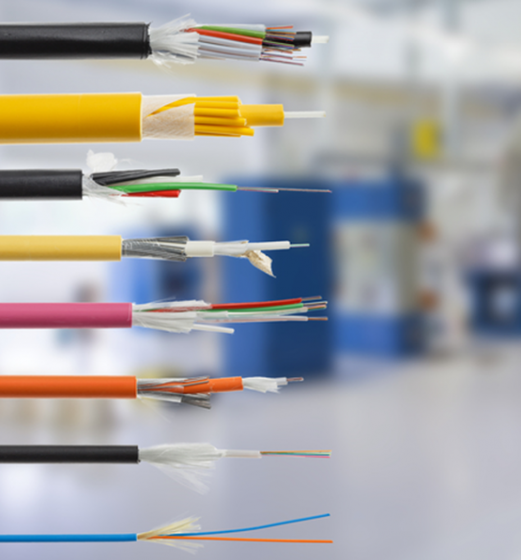
(1) tight cushioning fiber
The tight-fitting protective coating of an optical fiber consists of one or more layers of polymeric material. This tight-fitting protective layer effectively protects the optical fiber from external influences. This coating must be easily removable when splicing the fiber. The nominal outer diameter of the coating is between 800 µm and 900 µm with a tolerance of ±50 µm. The specific outer diameter can be agreed upon between the user and the manufacturer. The color of the secondary coating on the tight-fitting sleeve must be easily identifiable throughout the fiber's lifespan.
Tight-buffered optical fibers are generally used as indoor optical cables.
(2) Loose tube fiber
One or more primary-coated optical fibers are wound into a loose tube, which is then filled with a hydrophobic thixotropic ointment. The loose tube is extruded from PBT or another suitable material. The wall thickness, inner diameter, and outer diameter of the casing meet the process design requirements, and each optical cable casing is distinguished by a pilot or full chromatogram. The performance of the filling ointment and the loose tube material meet relevant standards, and the ointment dripping performance within the tube meets the corresponding requirements. The optical fibers are colored within a specific color spectrum for easy identification. The optical fiber within the casing must have the corresponding excess length specified by the process.
(3) optical fiber tape
Optical fiber ribbons are formed by aligning multiple optical fibers in a straight line and coating them with adhesive. The optical fibers in the ribbon are arranged parallel to each other and can be made into 2-fiber, 4-fiber, 6-fiber, 8-fiber, 10-fiber, 12-fiber, or 24-fiber ribbons according to user requirements. The optical fibers in the ribbon must remain parallel to each other without crossing. When designing and manufacturing optical fiber ribbons, attention must be paid to the splicing of adjacent optical fibers in the ribbon, and the centerlines of the optical fibers must be straight, parallel to each other, and in the same plane. The thickness, width, flatness, and other geometric dimensions of the optical fiber ribbon must meet the requirements of the corresponding specifications. The fibers in the ribbon will be identified by a pilot color spectrum or a full color spectrum. Markings must be printed on each ribbon to identify the different ribbons.
Optical fiber ribbon constructions can be edge-bonded or integrally encapsulated.
(4) skeleton
The skeleton is extruded from polyethylene or polypropylene according to the specified number of slots. Most of the skeleton slots are spiral-shaped and can be converted to SZ-shaped slots when special requirements exist. One or more optical fibers or fiber optic tapes can be placed in each slot. The tank can be filled with ointment to block water, or left unfilled to create a completely dry structure (subcontracted with special-performance water-blocking tape). The core of the skeleton is typically made of metallic or non-metallic materials as reinforcement. The reinforcement must have sufficient elastic modulus and tensile strength, and the bond strength between the core reinforcement and the plastic must meet certain requirements so that the skeleton can meet the specified temperature stability and tensile test requirements. The overall dimensions of the skeleton slots must meet the requirements and remain uniform.
(5) reinforcement
The reinforcing element is used to improve the mechanical performance of the optical cable, specifically to enhance its tensile strength and thermal stability. As a reinforcing element in the optical cable, it should weaken or inhibit axial deformation of the optical fiber and improve the cable's mechanical properties and tensile strength.
Post time: Feb-17-2023